Selling a condo in Toronto is not the same as selling a house. The spaces are smaller, the buyer pool is different, and the margin between a property that sells in days and one that lingers for weeks often comes down to how well it was prepared. This guide covers everything condo sellers in Toronto need to know, from what to do before the stager arrives to what a professional staging actually involves, room by room.
In This Guide
Why is condo staging different from staging a house?
Direct Answer
Condo staging targets a specific buyer, typically younger professionals or downsizers, who are evaluating flow, storage, and lifestyle fit in a compressed footprint. Every square foot is visible and scrutinised. The goal is to make the space feel larger, brighter, and more functional than it looks on paper.
The majority of condo buyers in Toronto begin their search online. They're browsing listings on their phone, shortlisting properties based on photos before they've set foot through a door. That means the photography of your condo, shaped entirely by how it's presented, is doing most of the selling work before any showing takes place. A poorly presented unit is eliminated from consideration before anyone picks up the phone.
Small errors are also amplified in small spaces. In a three-bedroom detached home, an oversized armchair in the corner is a minor aesthetic choice. In a 650-square-foot condo, it blocks the sight line from the front door, makes the living area feel cramped, and photographs like a cramped storage room. Scale, proportion, and the relationship between pieces matter enormously in a confined footprint.
Toronto condo buyers are often comparing eight to fifteen listings simultaneously, and in a competitive building or neighbourhood, several of those listings may be nearly identical in floor plan, finishes, and price. Staging creates emotional differentiation. It gives a buyer a reason to prefer your unit over the one three floors down. That preference translates directly into stronger offers and faster decisions.
It's also worth noting that investment buyers, those purchasing a condo to rent out, respond to staging. A well-presented unit signals that the property has been well maintained. It photographs well for future rental listings. And in a building with multiple units for sale, a staged unit typically attracts stronger investor interest than a bare, vacant one. For full details on professional condo staging services from Kelly Allan Design, including what's included and how the process works, visit our dedicated condo staging page. A complete overview of all staging approaches is also available on our Toronto home staging services page.
What should you do before the stager arrives?
The work you do before the staging team arrives determines how effective the staging can be. A professional stager is not a cleaner, a handyperson, or a removal service, they're a designer who needs a clean, prepared canvas. Here's what needs to happen first.
Declutter aggressively
The working rule of thumb: remove 30 to 40 percent of everything currently visible. This applies to every surface in the unit, countertops, bookshelves, the top of the refrigerator, bathroom ledges, nightstands. It applies to closets, because buyers open closets. It applies to the medicine cabinet, because buyers open that too.
Personal photographs, collections, and hobby equipment should be packed and stored. These items make a space feel occupied by a specific person, which is the opposite of what staging achieves. Buyers need to see themselves in the space, not you. If you're still living in the condo during the listing period, rent a storage unit for the duration. The cost is negligible relative to a single offer improvement.
Deep clean, including the hidden spots
A professional cleaning before staging is non-negotiable. Buyers in the Toronto condo market are not forgiving about cleanliness, and neither are photographers. Specific areas that are consistently missed and consistently noticed:
- Grout lines, stained grout in kitchens and bathrooms reads as poor maintenance
- Appliance fronts and interiors, if the oven door is glass, buyers will look through it; if the fridge is visible during showings, the interior matters
- Windows inside and out, clean windows are the single most effective free improvement for natural light; light is one of the primary things buyers evaluate in a condo
- Balcony glass and floor, a grimy balcony door undermines the perceived value of outdoor space
- HVAC vents, dusty vents photograph poorly and signal to buyers that maintenance has been neglected
Address any deficiencies
Walk through the unit before the stager arrives and note anything that looks like deferred maintenance. Scuffs on walls should be touched up with the original paint colour, don't introduce a new colour at this stage, because mismatched paint patches photograph worse than the original scuff. Loose cabinet handles, running toilets, and burnt-out bulbs all get noticed. In a condo where buyers are paying close attention to every detail, these small things collectively form an impression of how well the unit has been cared for.
If the building hallway or elevator lobby is dated, that's fine, buyers accept that building common areas vary. Your unit needs to be pristine. The contrast between a polished, well-presented unit and a dated lobby actually works in your favour. It shows what a buyer could have if they purchase.
Coordinate with your building
Condo staging involves a truck, a crew, and a freight elevator. Buildings have rules about this, and staging day runs more smoothly when the logistics are handled in advance. Book the service elevator for staging day. Check whether the loading dock or visitor parking is accessible for the staging vehicle. Some buildings require written notice to the property manager before trades or deliveries are permitted. This is something Kelly Allan Design handles directly for condo clients. We know exactly what documentation is needed and how to coordinate with building management so that staging day proceeds without delays.
How should a condo living room and dining area be staged?
Direct Answer
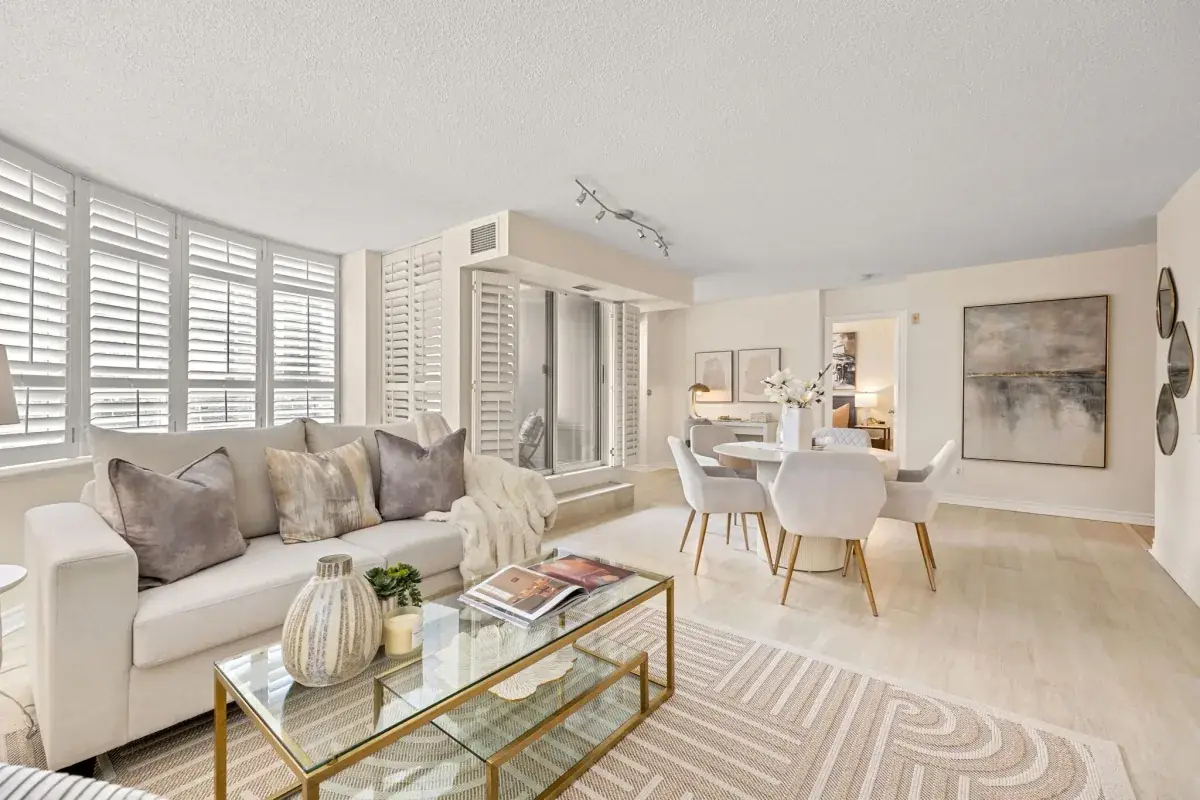
The living and dining area in a condo does the most work of any room. It's the first impression from the front door, it's where buyers imagine themselves living, and it appears in every listing photo. Scale, flow, and light are the three things a stager is solving for here.
Furniture scale is the most common mistake sellers make when presenting a condo themselves. An oversized sectional sofa that works comfortably in a suburban family room will make a 500-square-foot condo living area look and feel like a closet. Every piece of furniture needs to be sized for the room it's in, not the room the seller wishes they had. A stager will bring appropriately scaled pieces from their warehouse inventory, which is why professional staging consistently outperforms a seller's best efforts with their own furniture.
In an open-plan living and dining layout, which describes the majority of Toronto condos built since 2005, the two zones need to be visually defined. Buyers need to see clearly where the living space ends and where the dining space begins. Rugs are the primary tool here: a well-placed area rug anchors the sofa grouping and defines the living zone without requiring any architectural changes. A dining table with appropriate seating defines the dining zone. Without this zoning, open-plan condos read as one undifferentiated space and feel smaller, not larger.
Artwork should be large scale. This is counterintuitive for some sellers, who assume small rooms require small artwork. The opposite is true. A single large piece of artwork on a wall anchors the room and makes the space feel considered. Small art on a large wall reads as an afterthought and makes the wall, and therefore the room, feel smaller by comparison.
Mirrors, placed to reflect natural light from windows, add perceived depth and brightness. This is particularly effective in north-facing units or units with limited window area. A well-placed mirror can double the apparent light in a room in photographs.
Every piece of furniture should have a visual purpose and a clear sight line from the front door. Pieces that block the path through the room, interrupt sight lines, or serve no obvious function should be removed. The question to ask about every item in the space: does this make the room look larger, or smaller? Remove the ones that make it look smaller.
For photography, turn on every light source in the living area. If the overhead lighting is insufficient, which it often is in older condo builds, a floor lamp adds warmth and fill light without any permanent changes to the unit.
How should a condo bedroom be staged?
The primary bedroom in a condo should communicate one thing above all others: that this is a comfortable, calm retreat. Buyers evaluating a condo are partly evaluating whether they can decompress here after a day in the city. The bedroom needs to feel like an escape, not a storage room with a bed in it.
The bed should be well-dressed with a white or cream duvet cover and a minimal but intentional cushion arrangement. Hotel-quality presentation is the benchmark. Nothing on or under the bed, items stored under the bed are visible, and they make the room look cluttered even when the rest of the space is tidy.
Nightstands on both sides of the bed are important even in a small room. This signals that two people can comfortably live in the space, which broadens the buyer pool. A condo with nightstands on one side only reads as a single person's unit, this limits the perceived livability and can affect the range of buyers who see themselves there.
Wardrobe and closet doors should be closed if possible. If buyers are shown the closet, remove 40 percent of the contents before staging, buyers open closets, and a stuffed closet reads as insufficient storage, which is a significant buyer concern in condo purchases. Mirrors in the bedroom add light and perceived space, and are particularly useful in north-facing units where natural light is limited. Remove all personal toiletries and any visible medications from nightstands before photography and showings.
Den or second bedroom
A den or second bedroom is one of the most consequential staging decisions in a condo. An unstaged den leaves buyers uncertain about what the room is for, and uncertainty drives buyers toward the next listing. A clearly staged den removes that uncertainty and opens the unit to a wider range of buyers.
If the room is large enough to fit a bed, stage it as a bedroom. This is almost always the right choice, because it makes the unit appeal to buyers who need two bedrooms, a larger and more motivated buyer segment than those looking for a one-bedroom-plus-den. If the room is genuinely too small for a bed, stage it as a home office, but make the desk and chair intentional and attractive, not simply a table with a monitor on it. The principle in both cases: every room in the condo must have a clear, plausible purpose that a buyer can immediately understand and see themselves using.
How should the kitchen and bathroom be staged in a condo?
Kitchens and bathrooms are the two rooms where buyers make the most rapid quality judgements. They're evaluating condition, cleanliness, and finish quality in seconds. The staging goal in both rooms is to present a pristine, hotel-quality environment with as few distractions as possible.
Kitchen
Countertops should have a maximum of two decorative objects. The classic combination: a cutting board and a small potted plant, or a bowl of fruit and a cookbook. Choose two. Everything else, the dish rack, toaster, paper towel holder, coffee maker, goes in a cupboard for photography and showings. Buyers in the Toronto condo market have seen beautiful kitchens on Instagram and in showsuites; a cluttered counter with small appliances scattered across it compares unfavourably against that mental image.
Remove everything from the top of the refrigerator. The top of the fridge is a visual dead zone that reads as clutter regardless of what's stored there. If cabinet hardware is dated and the budget allows for it, replace it. This is typically a $100 to $150 investment that transforms the perceived modernity of a kitchen and photographs extremely well. If appliances are stainless steel, keep them fingerprint-free and polished for photography, fingerprints on stainless are highly visible in listing photos.
Bathroom
Remove all personal toiletries from every surface before photography. The counter should be clear. Buyers should see the countertop material and the finish of the faucet, not your products. Replace personal items with hotel-style staging: white towels folded and displayed, a candle, and a small plant.
Grout and caulk condition matters enormously in bathrooms. Grey or discoloured grout photographs badly and reads as poor maintenance. If the grout is in poor condition, have it professionally cleaned or regrouted before the listing. This is a relatively inexpensive fix with a disproportionate visual impact. Similarly, if the toilet seat is discoloured or cracked, replace it. This is a $40 to $50 fix that makes a measurable difference in how buyers perceive the overall condition of the bathroom.
Bathroom lighting should be warm white, not cool white. Cool white bulbs are clinical and unflattering. They make bathrooms feel like examination rooms. Warm white creates the spa-adjacent atmosphere that buyers are looking for.
Should you stage a condo balcony?
Direct Answer
Yes. Always. Balconies sell condos in Toronto. Even a Juliet balcony or a small terrace should be styled with at least a chair or a bistro setup. Buyers add substantial perceived value to well-presented outdoor space, and an unstyled balcony is a missed opportunity in any listing.
Outdoor space is at a premium in Toronto's condo market. A well-presented balcony communicates an entire lifestyle: morning coffee outdoors, a glass of wine at sunset, a place to grow herbs or container plants. An empty concrete terrace with a weathered patio chair communicates none of that, even when the balcony itself is identical in size and exposure.
For a small balcony, a folding bistro table and two chairs is sufficient. For a larger terrace, a full outdoor seating arrangement with a side table, a plant or two, and a lantern creates a compelling presentation that photographs extremely well. Even in winter listings, which are increasingly common as sellers prefer to list in January and February ahead of the spring rush, a clean, styled balcony with snow-resistant furniture or a simple decorative arrangement photographs well and demonstrates that the outdoor space is usable and cared for.
In Toronto's resale condo market, buyers consistently assign a premium to well-presented outdoor space. A staged balcony can represent $25,000 to $50,000 in perceived value differentiation between a unit that shows well and one that doesn't, particularly for south or west-facing units where the outdoor space has strong natural light.
As noted in the section above, dens should always be staged as either a bedroom or a functional home office. An empty den is the single most common staging oversight in Toronto condo listings and the one that is easiest to correct.
What does condo staging cost in Toronto in 2026?
Direct Answer
Condo staging in Toronto typically costs $2,000–$4,500 for a professionally staged one or two-bedroom unit as of 2026. This includes the staging plan, furniture and accessories delivery, installation, and removal after the sale. For a full breakdown by property type, see our home staging cost guide, or browse fixed-price ranges on our home staging pricing page.
| Unit Type | Typical Cost | Notes |
|---|---|---|
| 1-bedroom condo (under 600 sq ft) | $2,000 – $3,000 | Occupied or vacant. Living room, bedroom, kitchen styled. |
| 1-bedroom + den / 2-bedroom (600–900 sq ft) | $2,500 – $3,800 | Includes den or second bedroom staging. |
| 2-bedroom condo (900–1,200 sq ft) | $3,000 – $4,500 | Full staging across all principal rooms. |
| Penthouse or large condo (1,200+ sq ft) | $4,500 – $7,000+ | Premium inventory, larger crew, more rooms. |
What drives cost in condo staging: the number of rooms staged, whether the unit is vacant (more furniture required) or occupied (edit and enhance existing contents), and the calibre of inventory selected. Penthouse and luxury condo staging requires higher-quality pieces that match buyer expectations at that price point.
The return on investment is unambiguous. Staging a condo in Toronto typically adds 5 to 10 percent over the list price versus an unstaged comparable. At a staging cost of approximately 0.5 percent of list price, the ROI multiple is substantial. In Kelly Allan Design's experience, staged units in the same buildings consistently outperform their unstaged competition on both final price and days on market, regardless of the broader market conditions at listing time.
For a full breakdown of what staging costs across all property types, including detached homes, semis, and luxury properties, see our 2026 Toronto home staging cost guide.
★★★★★
"Jeff and his team did such a beautiful, thoughtful job staging our condo. We listed in June 2025, right in the middle of a rebalancing (but still soft) Toronto condo market, and it sold in just 6 days, close to our asking price."Gabrielle Garcia
Frequently asked questions about condo staging in Toronto
Ready to stage your Toronto condo?
Fixed-price quotes within 1 business day. Same-week installation across the GTA.
Request a Free Estimate