Virtual staging has become easy to find and easy to sell. For a few hundred dollars, a graphic designer digitally inserts furniture into photos of an empty room. The listing photos look polished. Buyers click. Showings get booked. And then the buyer opens the front door, walks into an empty house, and the entire illusion is gone.
That moment — from photo to front door — is where virtual staging fails. And it is precisely the moment that determines whether a showing becomes an offer.
In This Guide
What is virtual staging, and how does it work?
Direct Answer
Virtual staging is the process of digitally inserting furniture, art, and accessories into photographs of an empty property. A graphic designer works from photos of vacant rooms and uses software to render furniture into the image. The result is a listing photo that looks furnished. The property itself remains empty. Virtual staging exists in the photos only, not in the home.
The process typically works like this: a photographer shoots the empty property, the photos are sent to a virtual staging service, and within 24 to 48 hours, the same rooms are returned with digitally rendered furniture in place. The turnaround is fast. The cost is low, often $100 to $400 per room, or $1,000 to $2,000 for a full listing package.
From a purely technical standpoint, the results have improved significantly in recent years. Modern virtual staging software can produce photos that look, to an untrained eye, indistinguishable from real staging. The sofa looks real. The rug looks real. The art on the wall looks real.
None of it is.
In Ontario, the Real Estate Council of Ontario (RECO) requires that virtually staged photos be labelled as "virtually staged" in the MLS listing. This disclosure requirement exists for a reason: because without it, buyers would arrive at showings expecting to see what they saw in the photos. The disclosure tells buyers, in advance, that what they saw online is not what they will find in person.
The gap: from click to showing
Virtual staging optimises for online performance. The photos look better, the listing attracts more clicks, and more showings get booked. On this narrow measure, virtual staging works.
The problem is that clicks and showings are not the goal. The goal is an offer at the right price.
A buyer who clicks on a beautifully staged listing photo has formed an emotional impression of the property. They have imagined the sofa in that living room. They have pictured the dining table set for a dinner party. They have started, however briefly, to picture their life in that space. That impression is what motivates them to book a showing.
Then they arrive.
The room is empty. The sofa they liked does not exist. The warmth in the photos, the proportions, the sense of home, none of it is present. What greets them instead is bare floors, bare walls, and an empty room that looks smaller and colder than it did online. The showing has begun with a gap between expectation and reality that the buyer now has to mentally close on their own.
Most buyers cannot close that gap. Research on buyer psychology consistently shows that the ability to visualize an empty space as a home is not evenly distributed. The NAR's 2025 Profile of Home Staging found that 82 percent of buyers' agents say staging helps buyers visualize the property as a future home. Phrased differently: the majority of buyers need the staging to be physically present to make the emotional connection that leads to an offer.
Virtual staging gets buyers to the front door. Real staging is what converts that visit into a sale.
Why buyers decide with their feet, not their screens
Key Insight
Buyers make offers based on how a property feels in person, not how it appeared in photos. The emotional response that leads to an offer — "I can see myself living here" — is triggered by physical presence in a well-staged space. This response cannot be replicated by viewing photos in an empty room.
Home buying is an emotional decision that buyers justify with logic afterward. The logic comes later: square footage, proximity to schools, commute time, price per square foot. But the commitment, the decision that this is the one, happens at an emotional level, and it happens in the property, not on a screen.
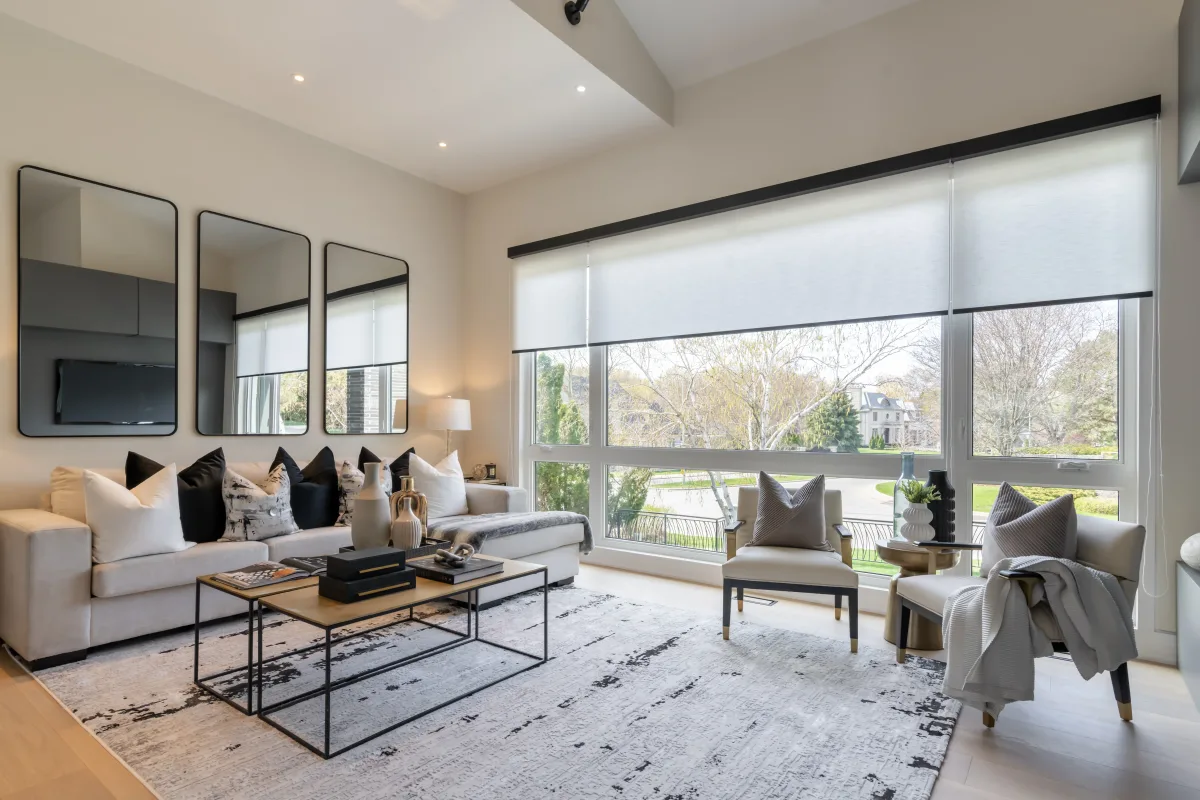
When a buyer walks into a well-staged home, several things happen at once. The room feels scaled and purposeful. The furniture tells them the room is big enough for a sectional, or that the dining space comfortably seats six. Natural light is drawn out by the way accessories are placed. The colour palette is warm and intentional. The buyer's nervous system is receiving signals that say: this is a place you could live well.
None of that happens in an empty room.
Empty rooms work against sellers
An empty room is, in a literal sense, harder to read. Without furniture for scale, buyers misjudge room dimensions. A 14-foot living room reads as cramped without a sofa to anchor it. A primary bedroom with no bed feels smaller than a staged one with a king and bedside tables. Buyers frequently leave showings of empty properties believing the rooms are smaller than they actually are.
Empty rooms also shift buyers into an analytical mode. Without a lifestyle to respond to, they start noticing the scuff on the baseboard, the crack in the ceiling plaster, the place where the previous owners' furniture rubbed against the wall. In a staged room, those same details recede. The eye goes to what's beautiful, not what needs fixing.
The showing clock
Buyers spend more time in staged homes. This matters because time spent at a showing correlates with offer likelihood. A buyer who spends 25 minutes walking through a property, lingering in rooms, sitting on the sofa (it is extremely common), and asking questions, is more likely to submit an offer than one who walks through in eight minutes and leaves. Staging earns that time. Empty houses do not.
What this means for negotiation
The emotional connection a staged property creates also affects the offer price. A buyer who has fallen in love with a home is less likely to submit an aggressive low-ball offer. There is a social and psychological cost to offering $150,000 below asking on a property they genuinely want. A buyer who felt nothing at the showing has no such reluctance. The asking price feels arbitrary to them, and any offer feels justified.
What the data shows about real staging
Sourced Data — As of Q1 2026
The Real Estate Staging Association's Q1 2025 report found every $1 invested in real staging returns $23.34. The NAR's 2025 Profile of Home Staging found staged homes sell 73% faster than unstaged properties. These figures are based on physical staging in occupied and vacant homes, not virtual staging.
It is worth noting what these statistics measure. The RESA and NAR datasets track results for properties that were physically staged, homes where the furniture was actually present during showings. These numbers do not apply to virtually staged properties, because the staging was not present when the buyers were there. The click-through performance of virtual staging is simply not the same thing as staging performance.
NAR's research adds a further dimension worth understanding for Toronto sellers specifically. Twenty percent of buyers' agents reported that real staging increases the final offer value by 1 to 5 percent, and 14 percent reported increases of 6 to 10 percent. On a $1.4 million Toronto detached home, a 5 percent improvement in the final sale price is $70,000. A 10 percent improvement is $140,000. No virtual staging service will produce a result like that, because virtual staging is not present at the moment the offer is made.
RESA also notes that sellers who do not stage, whether they choose virtual staging or no staging at all, face price reductions that run 5 to 20 times the cost of staging itself. The decision to skip real staging is not a cost-saving decision in most cases. It is a cost-shifting one, from the staging invoice to the final sale price.
Virtual vs. real staging: the honest comparison
Virtual Staging
- Improves listing photo quality for online platforms
- Lower upfront cost ($1,000 to $2,000 for a full listing)
- Faster turnaround (24 to 48 hours)
- Property remains empty during showings
- Requires RECO disclosure: "virtually staged" label on all photos
- No effect on the in-person showing experience
- Cannot generate an emotional connection at the property
- No measurable ROI data for final sale price improvement
Real Staging
- Improves listing photos AND the in-person showing experience
- Higher upfront cost ($3,000 to $6,000 for a Toronto detached)
- Requires 1 to 2 days for staging installation
- Furniture is physically present throughout the showing period
- No disclosure required — what buyers see online is what they find at the door
- Creates the emotional response that leads to offers
- Helps buyers accurately perceive room size and function
- $23.34 return per $1 invested (RESA Q1 2025)
The cost comparison deserves more context than the upfront numbers provide. Virtual staging is less expensive if the property sells quickly at the right price. But if the showing experience underperforms, and showings convert to offers at a lower rate, the additional days on market and the concessions made in negotiation erase the savings. For a Toronto property where each month of carrying costs runs $3,000 to $5,000, the math changes quickly.
Simply put: virtual staging is cheaper to start. Real staging is less expensive to finish.
When virtual staging is not the wrong call
There are contexts where virtual staging is a reasonable tool. Being clear about them helps sellers make an informed decision rather than a reflexive one.
Pre-construction condominium marketing
When a condo unit does not yet exist physically, virtual staging is the only available option. Developers marketing pre-construction units use virtual staging (and full interior renderings) to help buyers understand how a future space will look. In this context, there is no physical property to stage, and no buyer walking through an empty room. The digital presentation is the presentation.
Preliminary planning and investor documents
If a property owner is presenting a space to a potential investor, a lender, or a development partner, and no showing will take place, virtual staging can help communicate the potential of a space efficiently. Again, the goal here is not to convert a physical showing into an offer. It is to communicate a concept.
When the property is not available for showings
In rare situations where a property cannot be physically accessed for staging (tenanted homes where access is severely restricted, for example), virtual staging may be the only available improvement to listing photos. This is a specific circumstance rather than a general strategy.
For the standard case, a Toronto seller listing a residential property for sale on MLS, where buyers will physically visit the property, real staging is the appropriate choice. The showing is the sale. Anything that does not improve the showing does not improve the outcome.
How to think about this decision as a Toronto seller
Recommendation — As of Q1 2026
For Toronto sellers listing a physical property on MLS, real staging is the appropriate investment. Virtual staging improves photos. Real staging improves the showing. The showing is where offers are made. Kelly Allan Design has staged 500+ properties across the GTA since 2016 and does not offer virtual staging for active listings, because it does not deliver at the moment that determines the sale outcome.
Consider what you are actually buying
Virtual staging is a photography enhancement service. Real staging is a sale outcome service. These are different products solving different problems. If your only goal is better listing photos and you have no concern about the showing experience, virtual staging addresses that goal. If your goal is to sell faster and for more money, you need the tool that works at the showing, not only online.
Talk to your realtor before deciding
Experienced Toronto realtors have seen both approaches play out at scale. Most will tell you that the strongest offers come from buyers who had a strong showing experience, and that the gap between virtually staged photos and an empty property can undermine even a well-priced listing. Your realtor's experience with your specific neighbourhood and property type is valuable input on this decision.
Get the staging cost before ruling it out
Many sellers assume real staging is beyond their budget before checking. Kelly Allan Design provides fixed-price quotes within one business day, and for many property types in the GTA the cost is within the range that the first month's showing performance improvement will cover. Knowing the actual number is more useful than estimating.
For context on what staging costs for different property types in Toronto, see our detailed guide to home staging costs in Toronto, or visit the pricing page for package ranges.
Stage before photos, not as an afterthought
Whether you choose vacant staging or occupied staging, the staging must be in place before listing photography. The photos are the first impression online. Getting that right requires the staging to be physically present when the photographer arrives. Planning staging as a last step, after photos are taken, means either re-shooting (extra cost and time) or going to market with photos that don't reflect the staged property.
For sellers trying to decide between vacant and occupied staging approaches, our guide to vacant vs. occupied staging in Toronto covers the full decision.
Frequently asked questions
The illusion ends at the front door.
Real staging is what converts a showing into an offer. Fixed-price quotes within 1 business day.
Get a Free Estimate