Most sellers assume the kitchen sells the house. The data says otherwise. According to the National Association of Realtors' 2025 Profile of Home Staging, buyers' agents rank the living room as the single most important room to stage, ahead of the primary bedroom, and well ahead of the kitchen. If your budget or timeline does not stretch to every room, this is the order that matters.
In This Guide
Which rooms actually matter most to buyers?
Direct Answer
Per NAR's 2025 Profile of Home Staging, buyers' agents rank room importance as: living room (37%), primary bedroom (34%), and kitchen (23%). Separately, sellers' agents report the most commonly staged rooms are the living room (91%), primary bedroom (83%), dining room (69%), and kitchen (68%). The guest bedroom ranks lowest in buyer importance, at 7%. Source: National Association of Realtors, 2025.
There is a real gap between what sellers assume matters and what buyers' agents actually report. Kitchens and bathrooms get most of the renovation attention because they are expensive to change permanently. Staging works differently — it is temporary, and the rooms with the highest emotional weight for a buyer are the ones where they can picture themselves living, not necessarily the ones with the newest appliances.
If your budget covers full staging for every room, that is still the strongest outcome. But most sellers are making trade-off decisions, whether that is which rooms to declutter first, which rooms to prioritize in an occupied stage, or which rooms to focus a smaller budget on. The ranking below is the order to work through.
1. Living room
Why It's #1
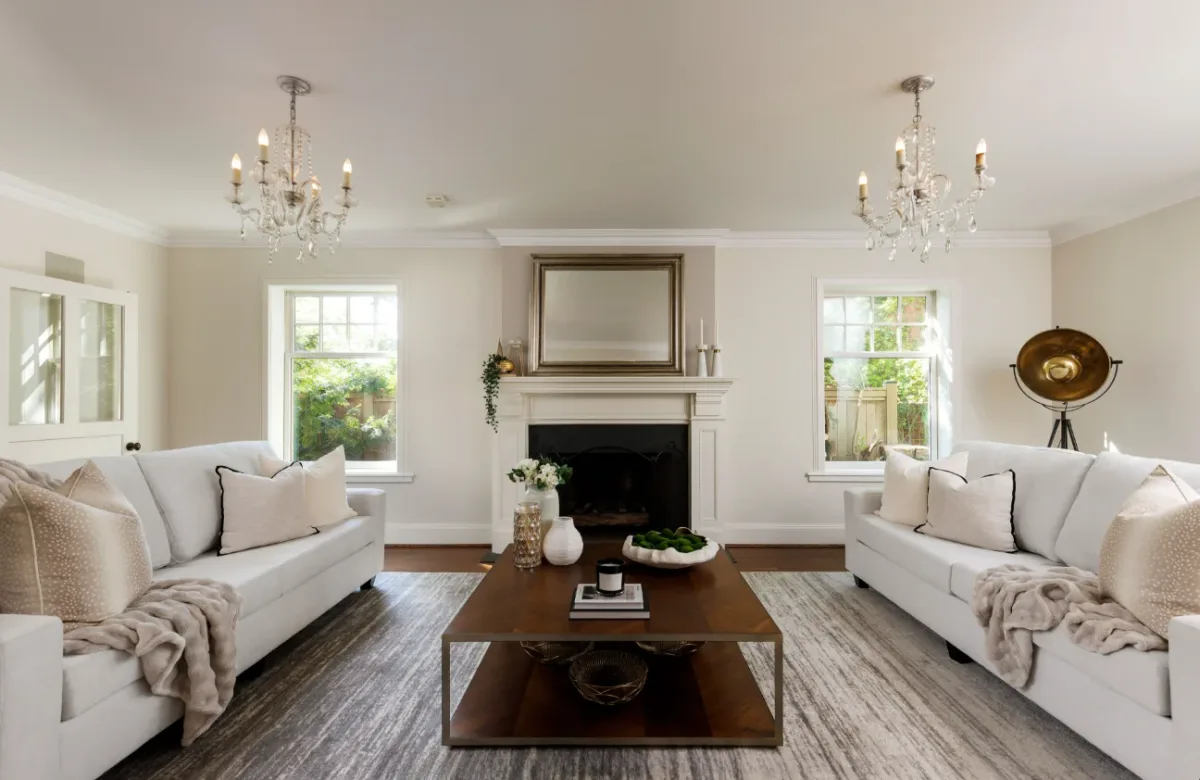
The living room is usually the first full room a buyer experiences after the entry, and it sets the emotional tone for the rest of the showing. It needs to read as spacious, functional, and move-in ready within the first few seconds.
Furniture scale is the most common living room mistake we see, in both directions. Oversized sectionals make a room feel smaller than it is — a particular risk in Toronto's condo living rooms, where every square foot of floor space is visible in listing photos. Undersized furniture in a larger detached home's living room can make the space feel empty and uncertain rather than generous.
Create one clear conversation area anchored by a rug sized to the seating, not the whole room. Keep pathways from the entry to the rest of the home visually open. Neutral upholstery with one or two intentional accent pieces (a throw, a piece of art, a single bold cushion) photographs better than a room with competing patterns or dark, heavy tones. Window treatments should stay minimal — natural light is doing a lot of the selling for you.
2. Primary bedroom
Why It's #2
The primary bedroom is where buyers picture their own daily routine. It needs to read as a retreat, not a storage room for the things that did not fit anywhere else in the house.
A made bed with layered, neutral bedding does more for this room than any other single change. Clear both nightstands down to one or two curated items. Remove exercise equipment, clothing racks, and anything that signals the room is doing double duty — even if that is exactly how you use it day to day. Closets should be visibly under 50% capacity when a buyer opens the door; a packed closet reads as insufficient storage, regardless of the room's actual square footage.
Personal photographs and strongly personal decor come down here more than almost anywhere else in the home. Buyers need to picture themselves in the room, and that is harder to do surrounded by someone else's family photos and memorabilia.
3. Kitchen
Still Essential, Just Not #1
The kitchen ranks third in buyer importance at 23%, behind living room and primary bedroom — but it is still staged by 68% of sellers' agents, and it remains a make-or-break room for condo buyers specifically.
Counters should be almost entirely clear: two to three curated items at most, not a full working kitchen setup. Remove refrigerator magnets, notices, and anything stuck to cabinet fronts. Small appliances not in active daily use should be packed away rather than left on the counter. A bowl of fresh fruit or a simple cutting board styled with a few ingredients does more work than most sellers expect for very little cost.
In Toronto's condo market, where kitchens are frequently open-concept with the living space, kitchen presentation and living room presentation need to work together visually — consistent tones, no clashing accent colours between the two spaces that a buyer will see in a single sightline.
4. Dining room
The dining room is a room sellers frequently underestimate. NAR data shows it is the third most commonly staged room by sellers' agents (69%), ahead of the kitchen (68%) — most listings that perform well do not skip it. It signals how the home functions for daily life and entertaining, which matters disproportionately for the family-sized detached and semi-detached homes common across the GTA.
A dining room does not need a full table setting with china and centrepieces to work. A cleared table, a simple runner or a few styled place settings, and a sideboard cleared down to one or two pieces communicates the room's purpose without looking staged in an obvious way. If the dining room currently functions as a home office or storage overflow, this is one of the highest-value rooms to reset before listing photos.
5. Primary bathroom
The primary bathroom did not appear in NAR's top rankings by percentage, but in our own experience staging 500+ GTA properties, it consistently punches above its weight for the size of the investment required. Bathrooms are detail rooms — buyers open cabinets, notice grout condition, and register personal products left on the counter in a way they do not in larger, more forgiving spaces.
Clear the vanity completely and remove all personal grooming products, medications, and toiletries. Replace worn or personal-coloured towels and bath mats with fresh neutral ones. Under-sink storage should be no more than half full when a buyer opens the door. Because bathrooms are small, a modest styling budget — towels, a bath mat, a single plant or tray — produces a disproportionately large visual improvement relative to cost.
Where not to over-invest
Budget Guidance
NAR data ranks the guest bedroom lowest in buyer importance, at 7%. If time or budget is limited, this is the first room to simplify rather than fully stage.
A guest bedroom, home office used only occasionally, or a basement rec room does not need the same investment as the living room, primary bedroom, or kitchen. Clean, decluttered, and neutral is enough for these secondary spaces. Buyers register them, but they are not the rooms deciding whether an offer gets written.
This matters most for occupied staging on a defined budget, or for sellers deciding which rooms to declutter first under time pressure. Work through the priority order above — living room, primary bedroom, kitchen, dining room, primary bathroom — before spending time or money on secondary rooms. A staging consultation with Kelly Allan Design will confirm the right allocation for your specific property before you start.
Frequently asked questions
Not sure where to start? We'll tell you.
Free staging consultation. We prioritize the rooms that will actually move the needle for your property.
Get a Free Estimate